Neville, H. A., Awad, G. H., Brooks, J. E., Flores, M. P., & Bluemel, J. (2013). “Color-blind racial ideology: Theory, training, and measurement implications in psychology.” American Psychologist, 68(6), 455–466. https://doi.org/10.1037/a0033282
Williams, D. A., Berger, J. B., & McClendon, S. A. (2005). Toward a model of inclusive excellence and change in postsecondary institutions. Washington, DC: Association of American Colleges and Universities.
The project is only beginning. Now that the semester is winding down, the only messages students want to see is “Congratulations Seniors” and “Have a great summer.” By the time I present, exams will be mostly finished and half of campus will have emptied out. However, a key leader of the Integrated Marketing Team will be attending that presentation, so I’m sure this will be ‘to be continued.’
Examination of the application of the theoretical grounding
When I talk about communications theory to my husband, I compare it to his true artistic passion: stage lighting. “Framework” is like the rigging and trusses that surround the stage. Choosing a specific theoretical “lens” is like choosing a particular color of light.
No single color or theory looks good or reveals all. One of the more commonly-used lighting techniques, the McCandless Method, combines a triangle of light – one corner warm, the other front corner cooler, and the back corner something that fits the emotional mood of the scene, such as violet. For my project, I see the theories of Agenda Setting and Uses & Gratifications as those front lights working together to make sure the message content is useful and appropriate. Visual rhetoric plays in the background to add depth and artistic flair.
Ethical impact/concerns
Again, with the end of the school year already here, no one is interested in designing messages. My main concern as I created the artifact was to be kind. I can’t say derogatory things about other people’s work. (Okay, I can and have, but I shouldn’t, especially on a public website.) I can lightheartedly poke fun at myself and show my own learning curve. I can also show commercially-available templates that are good for other purposes, but shouldn’t be used for digital signage messages.
Technical lessons learned
I built my site on WordPress several years ago, and this project let me play with some of their upgrades. I love the new(ish) customization to blog navigation menus. Only the landing page is an actual “page” and the rest of the content is on posts. The most important ones (dos, don’ts) are “sticky” posts and will always be at the top of the list, no matter how much content I add. This course portfolio is built with a similar custom navigation menu, pulling in all tags of the category COML602.
Other WordPress functionalities weren’t so fun to figure out. The drag-and-drop modules have several limitations. Usually I can tweak how something looks through HTML, but these editor panels wouldn’t work. Every site building program has similar issues, it’s the price we pay for having a good-looking and responsive website.
Limitations
Timing and scope are the project’s biggest limitations. I would have liked to get some user feedback as I developed the site, and could have got some in February or March. I would have liked to add a survey demonstrating the effectiveness of these best practices. I would have liked to conduct a survey with students in three different buildings where digital signage exists. These were not possible with the time frame.
Other Key Takeaways
So many times during this semester, I thought Digital Signage was a trite, pithy little subject. I felt like I was a wanna-be designer throwing a temper tantrum at something inconsequential. Before I arrived, the Dean’s Office didn’t think twice about posting slides with small text. I really want those screens to mean something to the students and faculty. Because I want my work to matter to students and faculty.
Revisions or suggestions for future iterations
I did not complete all of the items listed in my design prospectus. If I am able to present to campus groups or other message designers, I would expect to incorporate user feedback or FAQ into the content.
Surveys testing the best practices on our particular student demographic would be a beneficial study for the future. Other future work could include surveys of the types of content students would find most beneficial. Finally, the university could benefit from a campus-wide messaging system that included site-based granular content control remotely; that would require a significant investment in both technology and content management.
Digital signage has two communication goals: appeal visually to passers-by, and allow them to absorb a message instantly. This brings up two very distinct issues related to diversity and inclusion. The first is ethnic/racial/gender representation: awareness of how illustrations and images represent the population. The second is accessibility for color-impaired viewers: ensuring that contrasts and shades are visible to those with color blindness. This piece will examine each issue separately and offer solutions that mesh with the Gonzaga mission.
Representation
Williams et al. (2005) makes a strong case for developing a more-inclusive academic institution, from increasing the number of women and historically underrepresented populations in STEM to increasing knowledge about diverse cultures. It adds up to a feeling of ease and belonging among ethnically and racially diverse groups of people.
Digital signage plays a supporting role in the recommendations of “informal curriculum” content, as part of the “social dimensions of the campus environment.” Intergroup behaviors must be modeled in the messages promoted by the university. An academic institution can’t expect students to feel they belong unless they see images of students who look like them.
At the same time, no student should become the “face” of a particular group. If the engineering school only has one black freshman or one sophomore who wears a hijab, it is unethical to put that student’s image on more than one campaign. Likewise, it’s unethical to bring all of a school’s students of color together for a photo shoot, simply to make it seem like there is a more diverse student body. While the institution would like to model an inclusive campus, it is more important to value and respect the individuality of students (Wade, 2009).
Gonzaga University’s emphasis on cultural engagement came about in early 2017, specifically to affirm that “a commitment to diversity, equity and inclusion is an effort that requires the engagement of the entire institution, not one or two areas or programs” (McCulloh, 2017). University administrators release a statement periodically emphasizing their commitment to dismantling racial injustice receives a statement at least once or twice a year. For example, during Black Lives Matter protests, the deans jointly stated that “[racism’s] problems are systemic and so our response must be as well. Where hatred and marginalization exist for some, they exist for all” (Anderson, et al., 2020). Signage may seem insignificant, but only by examining all parts of a system can systemic racist practices be rooted out and replaced with fair, inclusive representation.
Color Vision Deficiency
The National Eye Institute (n.d.) estimates that 1 in 12 men of European descent and 1 in 200 women see color differently. Some can’t see reds, others can’t tell the difference between yellow and green. Only the most rare type shows a world of grays. Because a significant population mistake one color for another, it is important to consider color in graphic communication design.
Web developers are expected to meet the Web Content Accessibility Guidelines (WCAG), an international standard to allow people with disabilities easier access to the Internet (Henry, 2022). Digital signage shares some elements with websites, and some of the same accessibility practices should be followed to ensure inclusive communication, specifically those related to color contrast and typefaces (Disability Access Services, 2014). Where the signage project addresses these best practices, extra emphasis and context should be given for elements that address color blindness.
Raising awareness of color vision deficiency and taking steps to encourage accessibility is in line with the Gonzaga accessibility policy. In accordance with the Americans with Disabilities Act, all faculty and staff are to “provide equal access for persons with disabilities… to all educational programs, employment, activities, events, and services which it operates” (EITA, n.d.b). This extends to equal access to electronic information, both inside and outside the classroom. “Creating an accessible environment means any person—with a disability or without—has the same opportunity to independently access information, participate, and obtain services” (EITA, n.d.a). As long as visual communicators have the presence of mind to design for accessibility, the extra effort promotes an inclusive and welcoming environment.
Conclusion
“Color blindness” is also a term for a racial ideology suggesting that the American society has “moved beyond race and racism” (Neville et al., 2016. p. 6) and that the color of one’s skin doesn’t matter. Bonilla-Silva is credited with framing this ideology as a type of racism itself, as it literally whitewashes conversations about discrimination and privilege – anyone who then addresses racial inequities is seen as racist (Neville et al., 2013).
Instead, my digital signage project wants to emphasize color wherever possible – both as a celebration of diversity, and as a visual communication tool. In both cases, use of ‘color’ depends on how the most underrepresented audience members see the messages. In mathematics, fractions are simplified to the lowest common denominator; in this place where STEM is taught, I look for the most uncommon denominator to consider that perspective. Only by looking at the whole spectrum of color can a missing section be noticed.
I’m a fan of the Potter Box Model of Reasoning – a moral analysis tool introduced by a professor of social ethics and expanded on by C.G. Christians (2013). By looking specifically at four characteristics of an issue, one at a time and in particular order, Christians argued that practitioners could understand any conflicting values and weigh them appropriately. The first characteristic, the situation review, is located in the Design Prospectus. This paper examines my Digital Signage project through the lenses of values, ethical principles, and loyalties, determining any dilemmas and guidelines towards approaching those dilemmas.
Identify Values
I’m a fan of the Potter Box Model of Reasoning – a moral analysis tool introduced by a professor of social ethics and expanded on by C.G. Christians (2013). By looking specifically at four characteristics of an issue, one at a time and in particular order, Christians argued that practitioners could understand any conflicting values and weigh them appropriately. The first characteristic, the situation review, is located in the Design Prospectus. This paper examines my Digital Signage project through the lenses of values, ethical principles, and loyalties, determining any dilemmas and guidelines towards approaching those dilemmas.
Any messages displayed on the digital signage should reflect one or more of the institution’s specific values. These messages include implied messages, inferred through the choice of images displayed on the screens.
Values are the “fundamental beliefs that guide our behaviors and decision-making process” (Public Relations Society of America, 2000). This particular institution’s goal is to create “engineers for others,” and values all of the traits that are included in that ideal: an exceptional understanding of math, physics, and engineering principles; applying that knowledge innovatively yet safely; using engineering to contribute to society’s long-term advancement (as opposed to individual gain) or environmental stewardship; loyalty to the Jesuit educational tradition (which includes curiosity and academic integrity over dogma); and communicating openly and treating people fairly (School of Engineering and Applied Science, n.d.).
Expectations of the digital signage therefore include:
Open, clear, truthful messages
Promoting extra-curricular opportunities to learn or apply engineering knowledge and skill.
Promoting other elements of campus which support understanding of society’s needs and/or environmental needs.
Fair representation of the student body
Ethical Principles at Work
To ground the interpretation of the values, Christians (2013) insists on picking a general ethics law or rule that provides a guide for action, and using it as a lens to view the situation in question. Christians himself would suggest a communal responsibility interpretation of Agenda Setting Theory, based on the Judeo-Christian understanding of agape. The term, frequently used in the New Testament (written in a form of Greek) means “a form of love that is voluntarily self-sacrificial and gratuitous” (New World Encyclopedia, 2018). This unjustified, non-romantic love is the basis for community, Christians writes (1993).
Agenda Setting Theory posits that editors’ choices of which stories to cover shape how an audience thinks about the world (Griffin et al., 2019). From a news standpoint, corporate ownership and monopolies “raise disturbing questions regarding who decides what is and is not reported and whose interest is served,” Christians writes (1993, p. 158). In calling for a communitarian transformation of the media, he asked that they work with the community to encourage the public to make rational decisions. In summing up a passage from Thomas Jefferson, Christians explains, “Assuming that humans are rational animals, the press advances society’s interests by feeding an individual’s capacity to reason and make decisions” (1993, p. 89).
Identifying Loyalties
The digital displays in question may not be hard news, but its messages include announcements that the university wants the community to hear. Are those messages in the community’s best interests? If not, whose interests are most important to the sign’s message curator – the person paid by the school to add messages to a school-owned display? “In the pursuit of socially responsible media, clarity regarding ultimate loyalties is of paramount importance” (Christians, 2013, p. 5). In this case, the curator could point to Our Values: “We communicate openly” (School of Engineering and Applied Science, n.d.) and argue that means truthfully, fairly. In the end, the school’s Dean’s wishes must be respected, whatever the decision.
Conclusion
In today’s social climate, where authority figures are less trusted than in the past (Pew Research Center, 2022), it is likely that students already recognize that the digital screens are curated by the school, and not by a student-run system. Judging by the amount of times students tell the front office staff, “I didn’t know,” students are already choosing to ignore email messages sent by the university. By creating messages that can be visually absorbed at a glance, I am in many ways forcing messages onto our students, whether they choose to act on them or not. It is only ethical to make those pervasive messages in those same students’ best interest. Ideally, the school’s interests and the students’ interests mesh. In the cases where university and school messages conflict, the signage is the property of the School of Engineering and Applied Science, and will reflect the values we wish to impart on our students.
My proposed project aims to improve the quality of digital displays on Gonzaga’s campus through visual comparison and demonstration of best practices.
Ethical Considerations
This project takes into account three specific needs: 1) Emphasizing messages that are in the audience’s best interest, 2) Recognizing diversity while valuing and respecting the individuality of students, 3) Ensuring that these visual messages will be compatible with ADA guidelines for graphical information.
Audience’s Best Interests
Messages on billboards/digital signage are intended to be absorbed at a glance, and this makes them more pervasive than other forms of promotional media (such as posters or newspapers). If our audience – campus students – have little choice but to see these messages, then those messages should be in their best interest. I discuss this further in the Ethics section of this site.
Diversity
While seeing images of people who ‘look like me’ helps recruit a diverse student population, no student should feel that they have to ‘represent’ any particular demographic. I discuss this further in the DEI section of this site.
ADA Accessibility
Visual impairment and color blindness have inspired a set of guidelines around web design. Those same guidelines should be applied to the designs for digital signage. I discuss this further in the DEI section of this site.
Objectives
Campus departments will produce digital screens which will follow best practices of billboard communication. Students will be able to absorb these communications at a glance.
Assessment
As slide/signage quality improves, 50% more slides from student groups and university departments will be accepted by the School of Engineering and Applied Science.
Project Outline
My existing portfolio website includes a handful of slides created for public radio audiences. This site will be expanded with an explanation of best practices (as described earlier in this paper), and posts showing case studies which dive deeper into individual concepts.
Landing Page will include images of existing screens in use on the Gonzaga campus, a short introduction to digital signage as billboards, and a visual summary of the most important advice: use one image, tell one message, use one font family, don’t use white, and fit the screen. Each piece of advice will link to supporting evidence in a post.
Secondary page 1, “Do you make these common mistakes?”: This page will visually point out elements common to fliers or slide presentations that make a billboard-style digital sign unreadable. Each “mistake” will link to a blog page going deeper into that topic. Examples include:
Multiple messages – One Message
Too small – Size Matters
Too much picture – Overstuffed
Too much text – Short & Sweet
Multiple fonts – One Font to Rule them All
Multiple pics – A Picture’s Worth
Multiple QR codes – Code Overload
Vertical on a horizontal screen – Fit the Screen (Black Bands Mean Death)
Secondary page 2, “Think Billboards, not Presentations” will summarize the context of digital signage use, describing why the designs for flyers or presentation slides don’t have the same impact on a billboard audience.
Blog/Vlog posts, approximately a dozen, will demonstrate and describe a particular design element or best practice/poor practice through a case study or demonstration. In addition to titles listed above, a demonstration would show techniques to turn a vertical flyer into one or more digital signs.
Process
Confirm site design. Since I am utilizing a site already in existence, important decisions such as style and site theme are already chosen. The site will only need to be reviewed to ensure that the existing theme can handle the additional pages and separate blog (likely collected by tags).
List and Collect Images
Review latest SEO standards
Write page/blog content, incorporating SEO standards
Record and edit video for publishing
Discuss content with Integrated Marketing Team leadership in the Marketing and Communications office. Their endorsement of the content will be crucial in peer support of the concepts, and promoting the site itself.
I’d like to thank the academic world for not turning its collective nose up at the thought of trade journals incorporated into a literature review.
This project is rooted in advertising, and borrows from psychology, visual art and typography. The reason I can describe ‘best practices’ is because billboards and similar digital advertising is a multi-million dollar industry where businesses have to demonstrate ROI to justify the expense. A commercial outdoor signage company can’t afford to have clients deliver an ineffective message design, then blame the campaign failure on the idea of billboard/signage marketing. It’s in the signage company’s best interest to teach proper design technique.
I put this project’s formal (and academically-written) Disciplinary Grounding into a paper you can download here. Portions are scattered throughout this Digital Signage website.
After writing the grounding, I discovered additional applicable literature from discourse analysis, particularly visual discourse. It’s related to semiotics, and helps us talk about how society visual media — including film, photography, print and digital advertising. Expanding that out to visual rhetoric (theories on visual illustration of information) leads to more content, including from Purdue’s OWL! (Every person writing academic papers should know about this Online Writing Lab; I owe them so much.) Those readings reinforced the information I had already referenced, and would lead this project down a rabbit hole of over-examining visual messages as deep artistic messages — interesting on a psychological level but impractical for taking care of business. Peggy Albers (2007) particularly summarizes the concept of spacial orientation — the importance of where in a two-dimensional space content is located and how the eye wants to flow (at least, in Western societies).
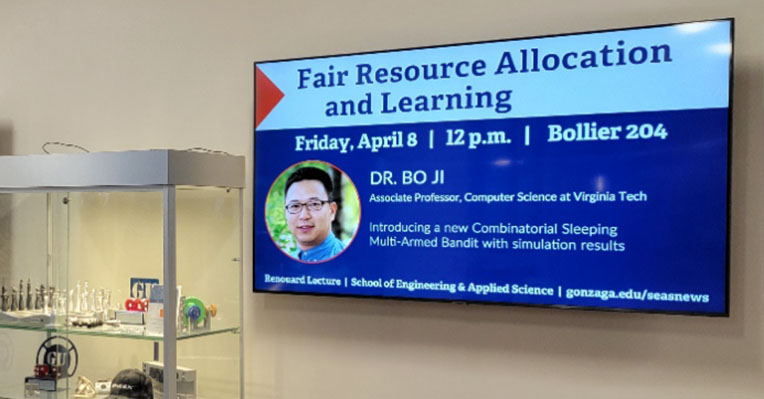
A small part of my work at Gonzaga involves managing content on three smart screens installed in a large atrium hallway. Hundreds of students, staff and faculty walk by at least one of these screens every day, and prospective students and their families stop nearby on frequent tours. This is an ideal place to put photographs of the engineering and computer science work being done, as well as announcements and positioning statements.
When they heard I had changed up what I was doing with our smart screens, other campus departments began to submit their messages. Most were things that would be helpful — career service offerings, job fairs, mental health support, stress relief, messages surrounding our Jesuit value of Cura Personalis (care of the whole person). The problem: most of the slide submissions were designed like presentation slides. But these were in a hall with a lot of foot traffic. These didn’t have a captive audience reading every word. The lettering was tiny or in a fancy font that wasn’t instantly legible. Instead of absorbing the message with a glance, students took a glance and quickly looked away.
Bottom line, I know there’s a better way. By rethinking the “slides” on digital signage as “billboards,” and applying those best practices, I truly believe our campus can improve messaging efforts.


 Communication By Design