
It took 30 years for my career to journey from Gonzaga’s ‘College Hall’ to the main engineering building only 100 meters away.
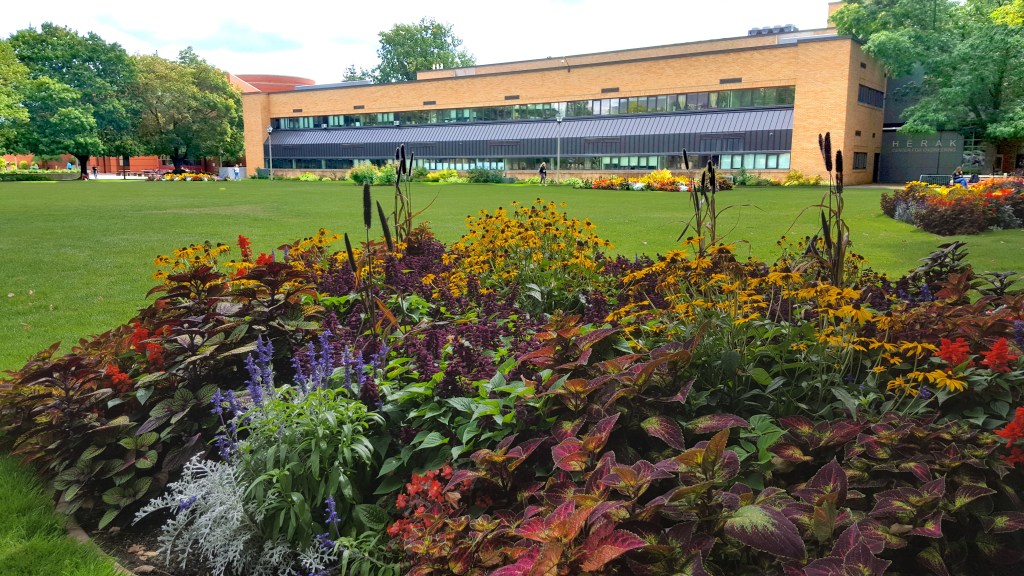
In spring 1989, in the newspaper computer lab on the top floor of what was then called the ‘Ad Building,’ a group of fellow undergrad journalism students and I read through story submissions from the beginning reporting students. A report of an engineering event included a few brief descriptions of upcoming senior projects – including a supercollider underneath the grass quad between our building and the Herak Engineering Center.
We printed it. We soon learned that we’d been pranked. A supercollider couldn’t fit in that 90-meter-square space, and one certainly wouldn’t fit the budget of our little Jesuit institution. That week, much of the university had a good laugh at our expense.
The Gonzaga Bulletin students all learned many lessons from that major mistake. One of the most eye-opening lessons for me was that NO ONE in our journalism group knew anyone to talk with inside Herak, much less what happened there. Even though it was physically less than 100 meters away from us, I couldn’t even imagine the technical mysteries that lurked behind those doors. I didn’t dare go in. If I did, I believed someone would quickly realize that I didn’t belong there. I wasn’t math-smart enough.
Thirty years later, not only do I work in Herak every day, I serve an important purpose: telling the stories of the current students and faculty of the School of Engineering & Computer Science. By learning about their projects and research, I can help translate the technical talk so a non-tech audience can begin to understand and appreciate the work. I might not have the same knowledge base as my coworkers, but I certainly do belong.
In terms of community, I know I belong because students and professors both smile and say hi to me. Students come to me for photos of their class or club projects. Professors let me know what students to watch because of their extra effort or accomplishments, or ask me to help publicize a talk or other event they’re involved in. Frequently, visitors linger in my office to soak in the brightly-colored art or admire the geek-pop-culture collection (there’s a reason the Harry Potter Club asked me to be faculty advisor!)
In terms of professionalism, I know I belong because colleagues and supervisors ask my advice or trust me to handle sensitive communication needs. Academics love words, but the general public gets more out of pictures. It can be difficult to get the right combination of text and images; marketing a technical school takes extra effort to build and label an image library that satisfies everyone’s needs. Just as a history department wouldn’t want to be represented by a photo from a poetry reading, mechanical engineers don’t want to be represented by civil projects. The learning curve demands patience and empathy, and is well worth the effort.
In terms of basic humanity, I now know I would have belonged 30 years ago simply by being a curious person. Tech-minded people like to explain what they’re doing to people who are willing to listen. Familiar concepts from one discipline can be completely unknown to another discipline; no one can expertly talk about everything in engineering or computer science. Students, staff, and faculty welcome anyone who walks through the Herak doors.

That doesn’t mean I always feel confident about my work. I worry sometimes that my learning curve makes the professors I write about think I’m dumb for getting something wrong, or I’m working too slowly. It’s a classic case of ‘imposter syndrome,’ which hits a lot of people in STEM fields – men of color or from working-class backgrounds, women of all backgrounds. Dr. Valerie Young, an imposter syndrome researcher, says that those of us with imposter syndrome are no less capable or competent than anyone else. We just have to get over it.
Luckily, ‘thinking like an engineer’ includes one of those ways to get over it. Advice from professional engineers* to our students is “fail fast, pivot, and move on.” In other words, pay attention to failure and make adjustments as soon as possible, or else the project wastes time and effort. Not only does that advice remind me to NOT dwell on the failure, it reminds me that some failure is inevitable. It’s expected. It’s the only way to grow. Fail, learn, move on to the next mistake.
That’s advice I wished I’d heard 30 years ago at The Gonzaga Bulletin while we scrubbed metaphorical egg off our faces. Looking back, having that experience in my first year of college made me a better researcher (and it made me ‘that friend’ who fact-checks posts on social media). As I work on my Master’s in Communication & Leadership from Gonzaga, I like to think it makes me a better student and communicator. Most importantly, it makes me want to be the person who lets people know what IS happening at the School of Engineering & Applied Science, so they can feel like they belong here, too.
* I’m using the term ‘engineers’ to include software engineers, aka programmers/computer scientists. Not all traditional engineers agree with that inclusion, but I’m sticking with it for this essay.
References
Young, V. (2017.) Thinking your way out of imposter syndrome. TEDNYC Idea Search, TED Archive. Retrieved from https://www.youtube.com/watch?v=h7v-GG3SEWQ Oct. 7, 2019.
 Communication By Design
One thought on “Two Different Worlds Within 100 Meters”
Comments are closed.