

“She who Rings the most, wins.” This is the reminder that, in barbershop contests, it don’t mean a thing if it ain’t got that ring. If the chords don’t ‘lock’ and make ‘overtones,’ it ain’t barbershop singing.
So here’s my problem: my ears have teflon. Overtones just slide right off me and I can’t really hear them.
That didn’t stop me from joining a Sweet Adelines Quartet in 2013. Amore is Bianca (lead) Andren (tenor) Melissa (baritone) and me (bass). While my personal tastes skew towards musical theatre, I’ve learned that certain older songs are the go-tos because of their song and chord structures. Most important is the chords – specifically, chords that create the iconic sound of Barbershop singing.
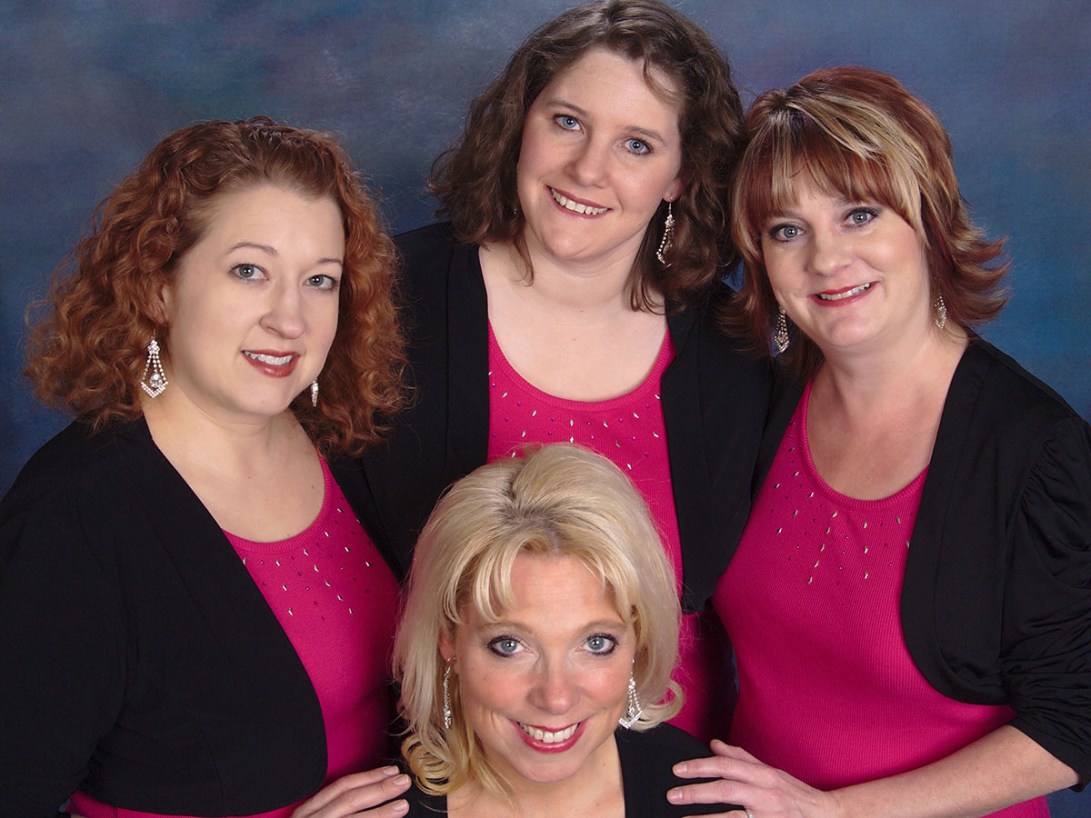
Overtones are that magical sound that makes barbershop a unique art form (and why ‘it all sounds similar’ to some of my family members). If you sing a single note, your ear hears only one tone. But run that sucker through a sound processor and you’d hear OTHER TONES in there too. An octave up, and octave down, and another note that’s somewhere around a third different.
I freaked myself out hearing my own overtone. I was singing in bed the other day. (Get your mind out of the gutter, I was alone. Hey, get your mind out of the gutter again.) I had the flannel sheet folded over right on top of my face — warm, but not suffocating. No one wants a dead bass. (I shall refrain from the usual baritone joke here.) Somehow that sheet was in just the right place in relation to my mouth and ears because in the vibrations of my note was ANOTHER NOTE in there! My family was gone and it wasn’t the guinea pigs. I don’t think it was the dog. But it was funky.
The point with overtones is that when you have four voices singing at certain intervals from each other, those overtones mesh. They (meaning barbershoppers) say it sounds like five separate voices.
I don’t hear five separate voices. I DO sometimes feel a bit of a buzz, though. Not a I’ve-had-a-drink buzz, but a vibration I can feel a bit on my ears, partially on my upper chest.
During a singing workshop, Sweet Adelines queen Kim Vaughn gave a master class and offered to help anyone who didn’t hear overtones. I stood right between her and fellow queen Susan Kegley as they hit a set of notes to create an overtone. I went into sound engineer mode. My brain turned into an ’80s monitor screen showing me two green sine waves oscillating at the same frequency. (Take that, high school trig teacher!) The buzz I felt was the peaks and valleys of that synchronized sound wave. A-ha, that’s gotta be the lock.
When the Amore quartet sings in a circle, I can feel that buzz. When we stand in usual quartet formation, standing out to the audience, I don’t feel it. I know we got it when my quartet-mates are happy. I can hear the distortion from our mic when we record and play back. But I can’t feel it unless I’m physically in the middle of it. Heck, I can hardly hear my own notes in a large room.
So how do I get through this major defect? I smile, sing it like we rehearsed it, and trust from our audiences’ smiles that they heard something they liked. Whether or not they got our ‘good vibrations’ doesn’t matter so much to me. Having fun listening to us? That means everything.
 Communication By Design