
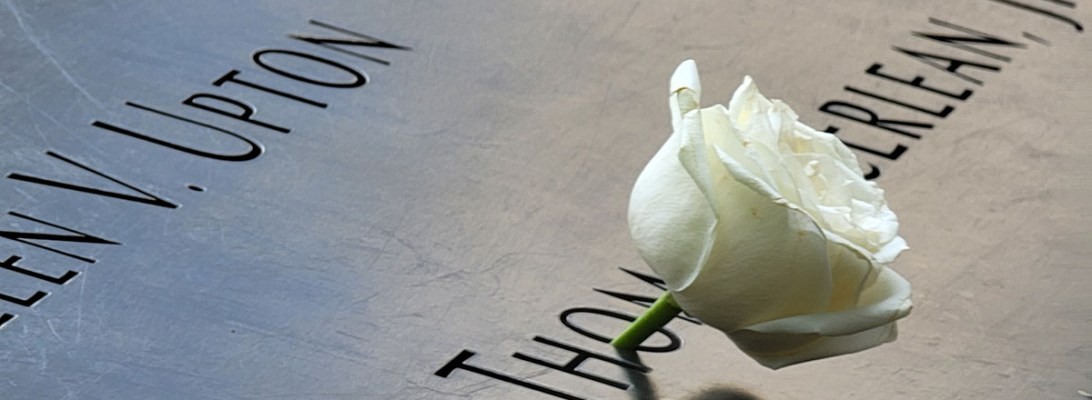
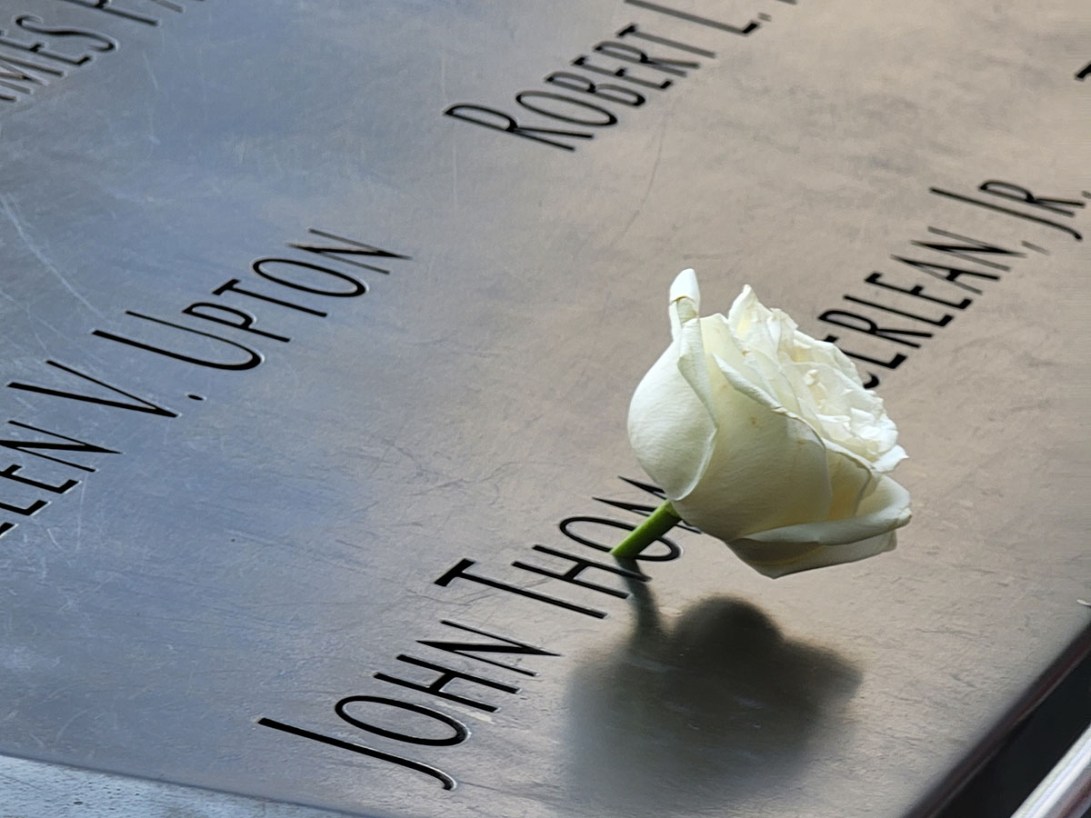
Birthday Rose at the 9/11 Memorial – JJS photo 2023
Most people remember September 11, 2001 through the constant barrage of television images, but for me and my colleagues at public radio, it was a day where gears shifted from ‘business as usual’ to the epitome of ‘essential service’ in a heartbeat.
It was the day I learned exactly what my professional adrenaline looks like.
Our radio clock was set to turn on at 7 a.m. PT. We expected to hear the standard top-of-the-hour newscast, but instead, we heard host Bob Edwards’ voice falter.
He said the unthinkable: he could not fully describe what he was seeing, but one of the Twin Towers in New York City had just collapsed.
Our sleepy heads jerked awake. We stared at each other for a moment, then rushed to the living room TV. The screen didn’t show New York, though; it showed smoke rising from a low, dense building I quickly recognized as the Pentagon. The Pentagon, too?
I jumped into some clothes and hopped in the car, stopping just long enough to pick up a dozen donuts—a small treat for a staff facing what promised to be a grueling day. I arrived at the station just after 7:30 a.m. to the news that the second tower had fallen.
The world was desperate for information. In times of crisis, National Public Radio is a global anchor—trusted for clear-headed, centrist reporting. But that morning, the sheer volume of global traffic did the impossible: NPR’s digital system crashed.
That system fed dozens and dozens of web-based news modules that put national news automatically on local station websites. A year earlier, I had worked as an NPR temporary project specialist, helping stations across the country integrate those same modules.
That project meant I had an NPR email, and it was still active. While the public-facing servers were buckling under the weight of a watching world, I could log into internal communications for real-time updates. I began manually typing the updates into the KPBX website.
Another plane crash in Pennsylvania, likely related. The FAA orders all flights grounded. Suspected hijackers identified.
For hours, I was the manual link between the national feed and our visual internet audience—people at work who didn’t have a TV or a radio but they had internet and felt transfixed by this tragically historic day.
Around 11 a.m., our program director cut away from the news speculation to regularly scheduled classical music—a necessary, somber grace note for a nation in mourning. I didn’t find the time to cry until later that day, sitting in the middle of a Mass at Gonzaga’s St. Aloysius Church.
By the time NPR’s external systems were back online, the narrative had shifted from the “what” to the “who.” I was able to pivot again, this time promoting stories of the Airway Heights community coming together to comfort stranded passengers.
Looking back, that day was a masterclass in why communications professionals do what we do. When the systems fail and the adrenaline kicks in, the job isn’t about the tools or technology—it’s about the people needing a sense of clarity. It’s about doing everything possible to provide that ‘essential service.’


 Communication By Design